Five drives into the Atlas Mountains from Marrakech in a rental car: the Ourika Valley, Imlil and Toubkal, Oukaimeden, the Tizi n'Tichka pass and the Amizmiz road. Distances, road conditions, which car and the best season.
On a clear winter morning you can see the snow on the High Atlas from the rooftops of Marrakech. The mountains start barely an hour south of the city, and with a rental car you can be walking beside a mountain river or having lunch in a Berber village before noon, then be back in town for dinner.
Tours run to the same places, but they keep to a fixed timetable and a fixed lunch stop. With your own car you choose the valley, leave before the tour buses, and stay as long as you like. This guide covers five drives from Marrakech, from an easy half day to a full crossing of the Atlas, with distances, road conditions, the right car and the best time of year for each.
Before you go: driving in the Atlas
All five drives below are on paved roads. You do not need a 4x4 for any of them in normal weather. Mountain roads are a different kind of driving from the city, though, so a few habits help:
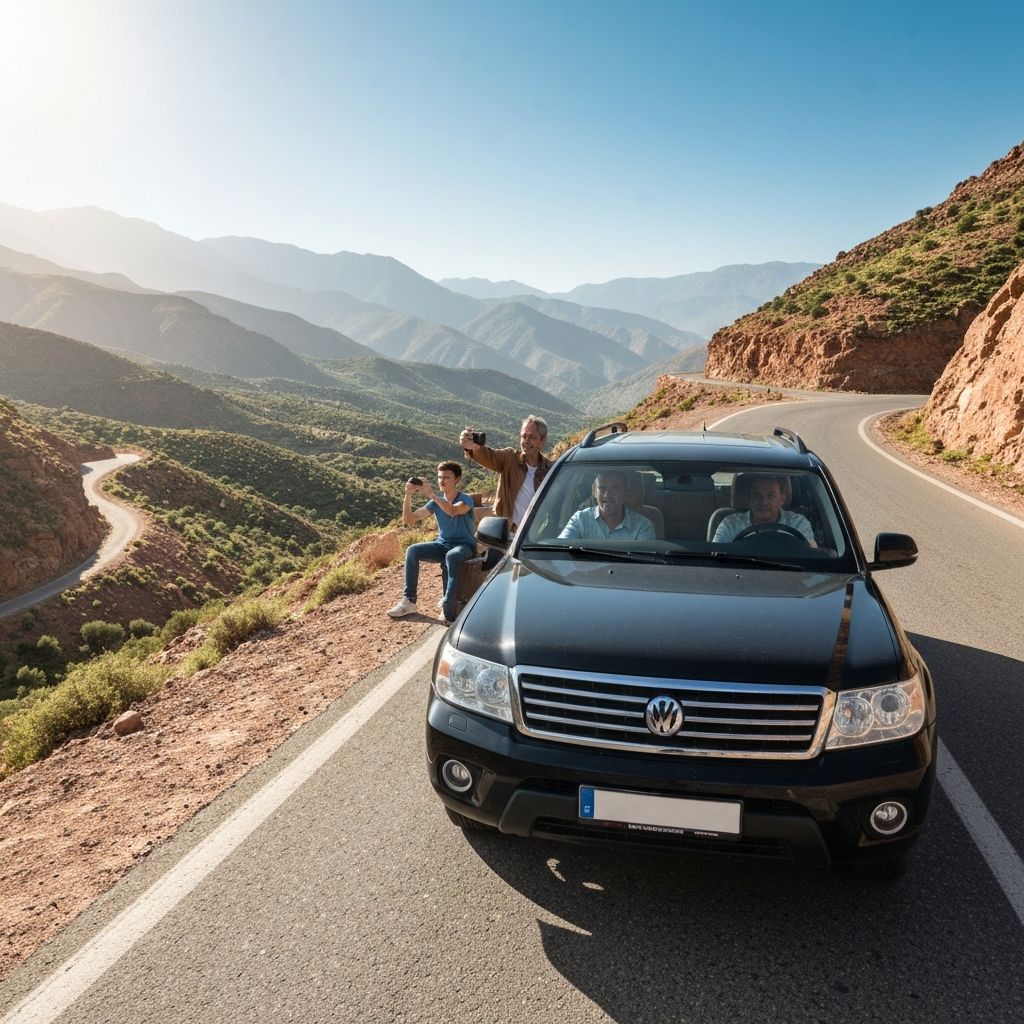
- Take the bends slowly. The roads are narrow in places, with no barrier on the valley side. Keep right, slow down before each bend rather than in it, and give a short tap on the horn before blind corners, as local drivers do.
- Use a lower gear going down. On long descents, let the engine slow the car instead of riding the brakes. With an automatic, use the lower gear position if the car has one.
- Expect people and animals. Villages sit right on the road. Children walk to school along the edge, and you will meet sheep, goats and mules.
- Fill up in Marrakech. There are fuel stations in the larger villages, but fewer as you climb.
- Police checkpoints are common at the edge of the city and on the main roads. They are routine, quick and polite. The officer usually asks for your driving licence, the rental contract and the car papers, which are in the glovebox.
- Watch the weather. The mountains are much cooler than Marrakech, and storms can build quickly in the afternoon. In winter, snow can close the high roads.
Drive 1: the Ourika Valley and Setti Fatma
Distance: about 60 to 65 km to Setti Fatma Driving time: 1 hour 15 minutes to 1 hour 30 minutes Best for: an easy half day or a relaxed full day
The Ourika Valley is the closest and easiest of the Atlas drives. The road leaves Marrakech heading south, crosses the flat farmland, then follows the Ourika river into a green valley lined with walnut trees, terraced fields and red earth villages. The paved road ends at Setti Fatma, a village known for its riverside restaurants and a series of waterfalls a short climb above the village.
Local guides wait in Setti Fatma to take visitors up to the waterfalls. The walk to the first fall is short but rocky, so wear proper shoes. The valley is popular with families from Marrakech at weekends, so go on a weekday if you can, and arrive in the morning for a parking space near the end of the road.
One safety rule: the Ourika river can rise very quickly after a storm in the mountains, even when the sky is clear in the valley. If it is raining higher up, stay away from the riverbed and the cafés built on the water's edge.
For the full route, the stops on the way and the waterfall walk, read our Ourika Valley by car guide.
Drive 2: Imlil and the foot of Toubkal
Distance: about 60 to 65 km Driving time: 75 to 90 minutes Best for: a day of walking with views of North Africa's highest mountain
Imlil, at around 1,740 metres, is the village at the foot of Jbel Toubkal, which at 4,167 metres is the highest peak in North Africa. The drive goes south through Tahannaout and Asni, then climbs a narrow, paved road for the last 17 km or so up a steep valley to the village.
That last stretch is the most demanding part of the drive: it is narrow, with tight bends and few places to pass. A small car manages it fine if you take it slowly. A Dacia Duster, with more ground clearance and a higher driving position, makes it more relaxed.
Park at the entrance to the village, where attendants look after the cars, and walk from there. Easy walks lead up to the village of Aremd and to small waterfalls in the side valleys. For anything longer, hire one of the local mountain guides in the village. Most visitors have lunch on a guesthouse terrace with the peaks in front of them.
Drive 3: Oukaïmeden
Distance: about 75 km Driving time: around 1 hour 30 minutes Best for: snow in winter, cool air and rock carvings in summer
Oukaïmeden is a ski resort high in the Atlas, often described as the highest in Africa. The road leaves the Ourika Valley and climbs a long series of bends to a wide plateau surrounded by peaks.
In winter, between December and March in a good year, there is snow for skiing and sledging, with simple lifts and equipment to rent on the spot. The road is paved and the snowploughs keep it open, so you do not need a 4x4: a good car with good tyres, such as the Peugeot 2008, does the job. Drive up slowly, keep your distance on the bends, and if snow is actually falling, wait until the road has been cleared. Ask us before you go and we will tell you how the road is that week.
In summer the plateau is green and cool when Marrakech is baking, and you can look for the prehistoric rock carvings scattered across the rocks around the resort.
Drive 4: the Tizi n'Tichka pass and Aït Benhaddou
Distance: about 190 km to Aït Benhaddou, 200 km to Ouarzazate Driving time: about 3 hours 30 minutes to Aït Benhaddou Best for: the great crossing of the High Atlas, ideally as part of a longer road trip
The Tizi n'Tichka is the main road across the High Atlas, climbing to 2,260 metres before dropping to Ouarzazate and the edge of the Sahara. It is fully paved and has been widened in many places, but it is still a long mountain road with many hairpin bends and a lot of lorries. Start early, take breaks at the viewpoints, and do not plan to drive it at night.
Past the pass, the kasbah village of Aït Benhaddou, a UNESCO World Heritage Site and the backdrop of many films, is the classic stop. Some drivers also take the smaller paved road to the old Glaoui kasbah at Telouet, a slower detour through quiet valleys.
This is too much for a comfortable day trip there and back. It works best as the first day of a longer loop: one night in Aït Benhaddou or Ouarzazate, then on to the Dadès Valley or the desert. Our 4x4 and SUV rental page has a full three-day Sahara itinerary that starts with this road.
In winter, snow can close the pass for a few hours, occasionally a few days, until the ploughs clear it. Heavy storms and rockfalls can close it at other times of year too. Check the conditions the day before you leave.
Drive 5: Lalla Takerkoust and the Amizmiz road
Distance: about 35 km to the lake, 55 km to Amizmiz Driving time: 45 minutes to 1 hour 15 minutes Best for: a short afternoon, or combined with the Agafay Desert
The quietest of the five drives heads southwest towards the foothills. The Lalla Takerkoust reservoir sits below the mountains, with lakeside cafés and wide views of the Atlas. Further along the same road, Amizmiz is a small market town at the foot of the mountains, with a weekly souk on Tuesdays where the villages come to trade.
The same road leads to the camps of the Agafay Desert, so it is easy to combine the lake, the foothills and a desert sunset in one afternoon. Our Agafay Desert by car guide covers that part.
Bonus: the Ouzoud waterfalls
Further away, in the Middle Atlas about 150 km northeast of Marrakech, the Ouzoud waterfalls drop around 110 metres into a gorge full of olive trees, with Barbary macaques in the woods around them. The drive takes about 2 hours 30 minutes each way on paved roads, so it makes a long but rewarding day. Arrive early, before the tour groups.
Which car for the Atlas Mountains?
For the five drives above, in dry weather:
- Ourika Valley, Lalla Takerkoust, the Tizi n'Tichka: any car. A small automatic like the Kia Picanto (€28/day) is fine, and an automatic makes the hairpins easier if you are not used to hill starts.
- Imlil: any car driven slowly, but the Dacia Duster (from €46/day, manual or automatic) gives you more clearance and a better view over the bends.
- Oukaïmeden in winter: a good car with good tyres is enough once the road is cleared. The Peugeot 2008 (automatic, €55/day) is a comfortable choice for the climb.
- Off-road pistes and sand: only the Toyota Land Cruiser Prado (€230/day), our only 4x4. None of the five drives above needs it.
The Duster is a two-wheel drive SUV: it is comfortable on mountain asphalt but it is not made for off-road pistes.
When to go
- Spring (March to May): the valleys are green, the almond and fruit trees flower, and the peaks still carry snow. The best season overall.
- Summer (June to September): the mountains are an escape from the heat of Marrakech. Go early, as afternoon storms are common in the high valleys.
- Autumn (October and November): clear skies, comfortable temperatures and the walnut harvest in the valleys.
- Winter (December to February): snow on the peaks and sometimes on the roads. Beautiful, but check the weather, and on the high roads drive only once the snowploughs have cleared them.
Atlas Mountains with children
Families love the Atlas, and a car makes it much easier than a tour. A few tips from our customers:
- Mule rides in Imlil are usually the highlight for children, and the local guides are used to small walkers.
- Bring something for car sickness if your children need it. The mountain roads are winding.
- Pack layers. It can be 10 degrees cooler than Marrakech, and evenings get cold even in spring.
- Stop often. Viewpoints break up the drive and children enjoy watching the landscape change from city to villages to mountains.
- Bring snacks and water. Village shops are small and have a limited choice.
- Stay a night in a guesthouse in Imlil or the Ourika Valley if you can. The hospitality is genuine and the morning light on the peaks is worth it.
Frequently asked questions
Can I drive to the Atlas Mountains from Marrakech myself? Yes. The Ourika Valley, Imlil, Oukaïmeden and the Tizi n'Tichka pass are all on paved roads within one to four hours of Marrakech. Take the bends slowly and drive in daylight.
Do I need a 4x4 for the Atlas Mountains? No. Every drive in this guide is on asphalt. Even Oukaïmeden in winter is fine in a good car with good tyres, such as the Peugeot 2008, once the road has been cleared. You only need a 4x4, our Toyota Land Cruiser Prado, for off-road pistes or sand.
What is the best Atlas Mountains day trip from Marrakech? For an easy day, the Ourika Valley and Setti Fatma. For walking and big mountain views, Imlil at the foot of Toubkal. Both are about 60 to 65 km from Marrakech.
Is the Tizi n'Tichka pass dangerous? It is a long mountain road with hairpins and lorries, but it is paved and well used. Drive it in daylight, take breaks, and check for snow or storm closures in winter.
Can I visit the Atlas Mountains in winter? Yes, and the snowy peaks are spectacular. The lower valleys stay open, and the snowploughs clear the high roads such as Oukaïmeden and the Tizi n'Tichka after a snowfall. Check the conditions before you go, take a car with good tyres, and wait if snow is still falling.
Rent a car for the mountains
We deliver your car to your hotel or riad in Marrakech, or meet you at the airport, with CDW insurance and unlimited kilometres included. Our cheap car rental in Marrakech starts at €28 a day, nothing is paid online, and you can cancel for free at any time. Before you set off, our guide to driving in Morocco covers the road rules and fuel.