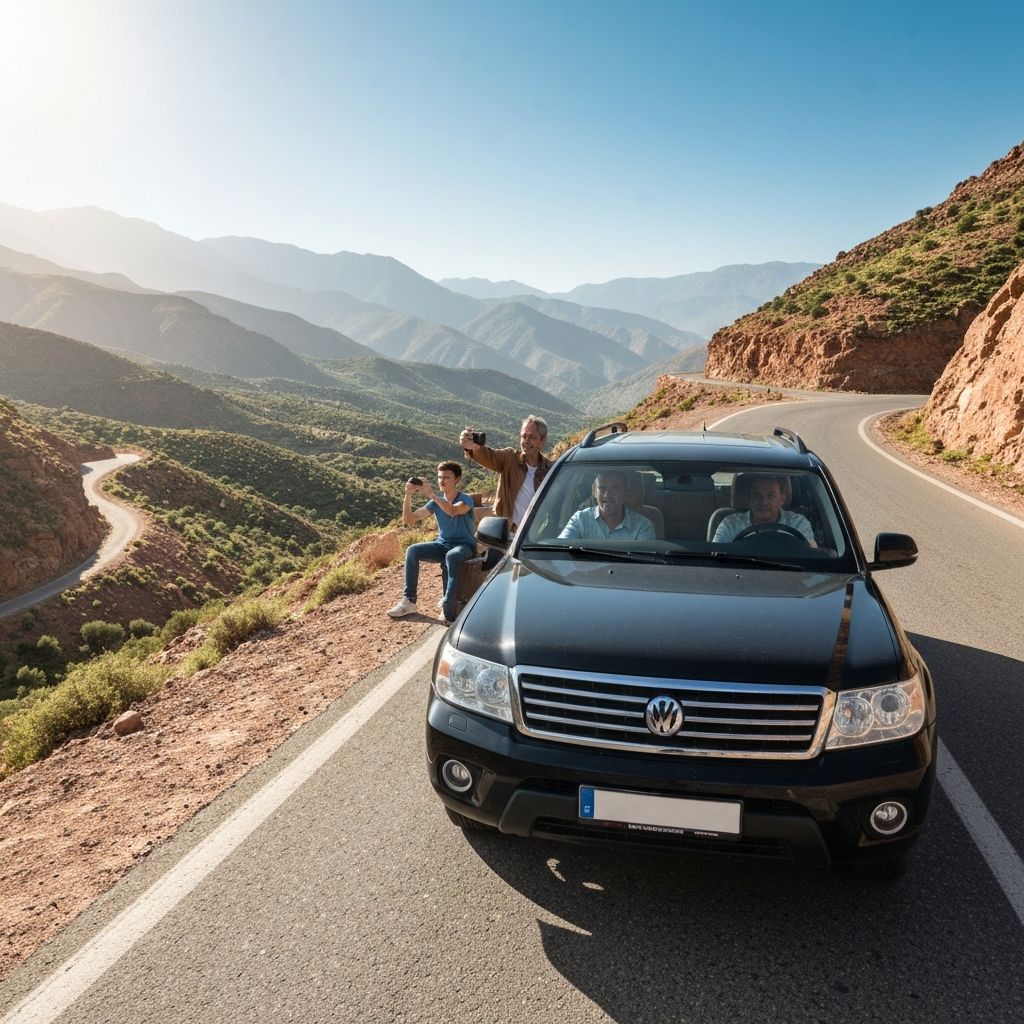
How to drive to the Agafay Desert from Marrakech in your own rental car: the route, the last gravel kilometres to the camps, which car you need, when to go and how to plan the day.
The Agafay Desert is the closest desert landscape to Marrakech, and one of the easiest trips you can make with a rental car. It sits 30 to 40 kilometres southwest of the city, which means 45 minutes to an hour at the wheel. There is no need for a two-day drive to Merzouga or a fixed tour schedule. You leave when you want, stop where you want, and come back when the light has gone.
This guide covers the route, the last few kilometres to the camps, which car you need, the best time of day and year, and how to plan the trip so you are not driving a gravel track in the dark.
What the Agafay Desert actually is
Agafay is a stone desert, not a sand desert. Expect rolling hills of bare, pale earth and rock, a few dry riverbeds, and on clear days the snow-capped peaks of the High Atlas on the horizon. There are no tall golden dunes like the ones at Erg Chebbi near Merzouga.
That is not a disappointment once you know it. The light at sunset turns the hills pink and orange, the silence is real, and the view of the Atlas behind the desert is something the Sahara does not give you. It is also the reason Agafay has become so popular: you get the feeling of the desert without spending two days on the road.
If you have your heart set on sand dunes, Agafay is not the place. Read the section on Agafay versus the Sahara further down before you decide.
How to drive to Agafay from Marrakech
The route is simple. From the city centre, head southwest past the Menara Gardens and take the road towards Amizmiz. It is a paved regional road that runs through olive groves and small villages, with the Atlas getting closer the further you go.
After about 30 kilometres you reach the area around Lalla Takerkoust, a village beside a large reservoir. Most of the Agafay camps are spread over the hills around and beyond this point. Each camp sends its own directions or a map pin when you book, and you should use them: the camps are not on one road, and the signs at the turnings range from clear to non-existent.
A few practical points for the drive out:
- Download the area for offline use in Google Maps before you leave. Signal is usually fine, but the turnings to the camps are easy to miss.
- Drop the camp's exact location pin into your map app the day before. A camp name alone often sends you to the wrong track.
- Fill up in Marrakech. There are fuel stations on the way out of the city, but very few once you are in the hills.
- Expect a police checkpoint on the way in or out of the city. They are routine, quick and polite. The officer usually asks for your driving licence, the rental contract and the car papers, which are in the glovebox. Keep them together with your passport.
Leaving the Medina or Gueliz in the afternoon, allow a little extra time for city traffic on the way out. Once you are past the edge of Marrakech, the road is quiet.
The last kilometres: which car do you need?
This is the question we are asked most often about Agafay, and the honest answer is: it depends on your camp and on the weather.
The main road is asphalt the whole way. The final stretch from the road to most camps is a gravel or packed-earth track, usually between one and five kilometres long. In dry weather, most of these tracks are fine in an ordinary car if you drive slowly and pick your line around the ruts and stones. A small car like a Kia Picanto or a Dacia Sandero gets there; you just take it gently.
A car with more ground clearance makes the track more relaxed. The Dacia Duster sits higher and handles firm gravel comfortably. It is a two-wheel-drive SUV, so it is not meant for loose sand or steep off-road climbs, but that is not what the camp tracks are.
A few camps sit further out on rougher tracks, and after rain some tracks turn to mud. In those cases you need a real 4x4, which in our fleet is the Toyota Land Cruiser Prado, or you leave your car at the road and let the camp collect you. Many camps offer exactly that, and it costs nothing to ask.
Two rules apply whatever you drive:
- Ask the camp before you book whether their track is suitable for a normal car. They answer this question every day.
- Stay on the access track. Driving out across the open desert is off-road driving, which is not covered by rental insurance in Morocco, and the stony ground is hard on tyres.
If you are unsure which car fits your camp, send us the camp's name on WhatsApp and we will tell you what we know about the track.
When to go
Best months: October to May. Days are warm and clear, and the Atlas often has snow on top from December to March, which makes the view behind the desert spectacular.
Summer: June to September is very hot in the afternoon, often above 40°C. Go late in the day, plan to arrive for sunset, and do not count on a midday walk.
Winter nights: from December to February the temperature after dark can fall close to freezing. If you are staying overnight, bring a warm layer even though the afternoon felt like summer.
Time of day: most people come for the late afternoon and sunset. In December the sun sets around 6 pm; in June it is closer to 8 pm. Aim to arrive at least an hour before sunset, so you drive the gravel track in daylight and have time to settle in.
Plan the day so you are not driving in the dark
The one thing we ask our customers to avoid is driving the camp track back to the road at night. There are no lights, the ruts are hard to see, and it is easy to take a wrong fork. You have three good options:
- Leave straight after sunset, while there is still some light, and drive the track before it is fully dark. The paved road back to Marrakech is easy at night.
- Stay for dinner and sleep at the camp. Most Agafay camps offer an overnight stay with dinner and breakfast, and waking up to the Atlas at sunrise is worth it.
- Park at the road and take the camp's transfer for the last stretch, so the night drive is only on asphalt.
A simple day plan
- Late morning: leave Marrakech by the Amizmiz road.
- Around midday: stop at Lalla Takerkoust. The reservoir has lakeside cafés and restaurants and wide views of the mountains.
- Afternoon: check in at your camp, or book an activity. Camel rides, quad and buggy tours and horse riding are offered by most camps and local operators.
- Sunset: watch it from the camp or a nearby ridge.
- Evening: dinner at the camp, then either the drive back while the light lasts or a night under the stars.
If you have a full day, Amizmiz, a small market town further along the same road at the foot of the Atlas, makes a good extra stop before you turn back towards the desert.
Things to do in the Agafay Desert
- Sunset and stargazing. Away from the city lights, the night sky is clear and full of stars. This is the main reason most people come.
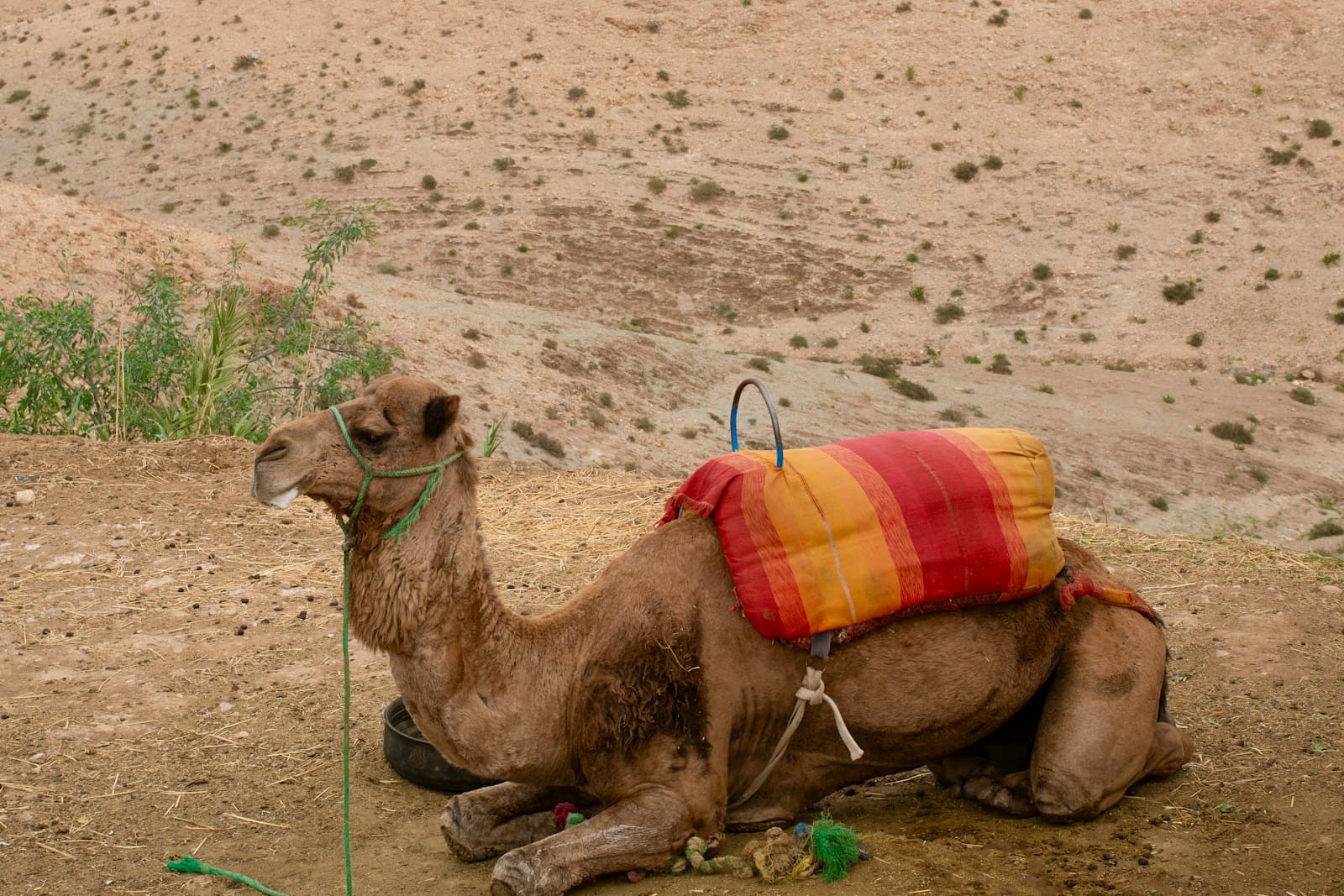
- Camel rides. Short rides of an hour or so are offered around most camps, usually timed for the late afternoon.
- Quad bikes and buggies. Run by local operators on their own tracks, with a guide. Leave your rental car parked for this: quads and buggies go where cars should not.
- Horse riding. Several stables around Lalla Takerkoust offer rides into the hills.
- Lunch or dinner at a camp. Many camps welcome day visitors for a meal with a view, even if you are not staying the night. Book ahead.
Agafay or the Sahara?
Agafay and the Sahara at Merzouga are very different trips.
- Agafay Desert: 30 to 40 km from Marrakech, 45 minutes to an hour by car. Stony hills with views of the Atlas. Half a day, or one night. Any car in dry weather; ask your camp about its track.
- Sahara (Erg Chebbi, Merzouga): about 550 km from Marrakech, 9 to 10 hours of driving, best split over two days. Tall sand dunes. At least three days there and back. Any car on the paved road; a 4x4 only for the sand tracks around the dunes.
If you only have a few days in Marrakech, Agafay gives you the desert experience without losing two days to the road. If you have a week and want dunes, plan the Sahara road trip instead. Our 4x4 and SUV rental page has a full Merzouga itinerary and explains when you need the Prado and when the Duster is enough.
Practical tips
- Water and snacks: there are shops in Lalla Takerkoust, but not once you are on the camp tracks.
- Cash: bring some dirhams for small purchases, tips and any activity booked on the spot. Parking with an attendant in Marrakech itself usually costs between 2 and 10 dirhams, depending on the place.
- Sun and dust: sunglasses, sunscreen and a scarf for the wind. Keep the windows closed on the gravel track to keep the dust out of the car.
- Shoes: the ground is stony, so trainers are better than sandals for walking up to a viewpoint.
- Insurance: CDW is included with our cars. If you want no excess at all, the optional Super Cover is worth considering for any trip that includes a gravel track.
Frequently asked questions
Do I need a 4x4 to visit the Agafay Desert? For most camps, no. The road is paved and the camp tracks are usually fine in an ordinary car in dry weather, driven slowly. A Dacia Duster gives you more clearance. Only a few remote camps, or any track after heavy rain, need a real 4x4 such as the Toyota Land Cruiser Prado. Ask your camp before you book.
How far is the Agafay Desert from Marrakech? About 30 to 40 kilometres southwest of the city, depending on the camp. The drive takes 45 minutes to an hour by the Amizmiz road.
Can I visit the Agafay Desert as a day trip? Yes. Leave Marrakech after lunch, arrive for the late afternoon and sunset, and drive back in the early evening. Many camps welcome day visitors for a meal.
Is it safe to drive back to Marrakech at night? The paved road back is easy at night. The gravel camp track is the part to avoid in the dark. Leave right after sunset, take the camp's transfer to the road, or stay overnight.
Can I rent a car and have it delivered to my riad? Yes. We deliver to hotels and riads in Marrakech for free, so you can take the car only on the day of your desert trip. See our car rental in Marrakech downtown page.
Rent a car for your Agafay trip
A small car is all most people need for Agafay. Our cheap car rental in Marrakech starts at €28 a day for a Dacia Sandero or an automatic Kia Picanto, with CDW insurance, unlimited kilometres and free delivery to your hotel included. For more ground clearance, the Dacia Duster starts at €46 a day. Nothing is paid online, and you can cancel for free at any time.